
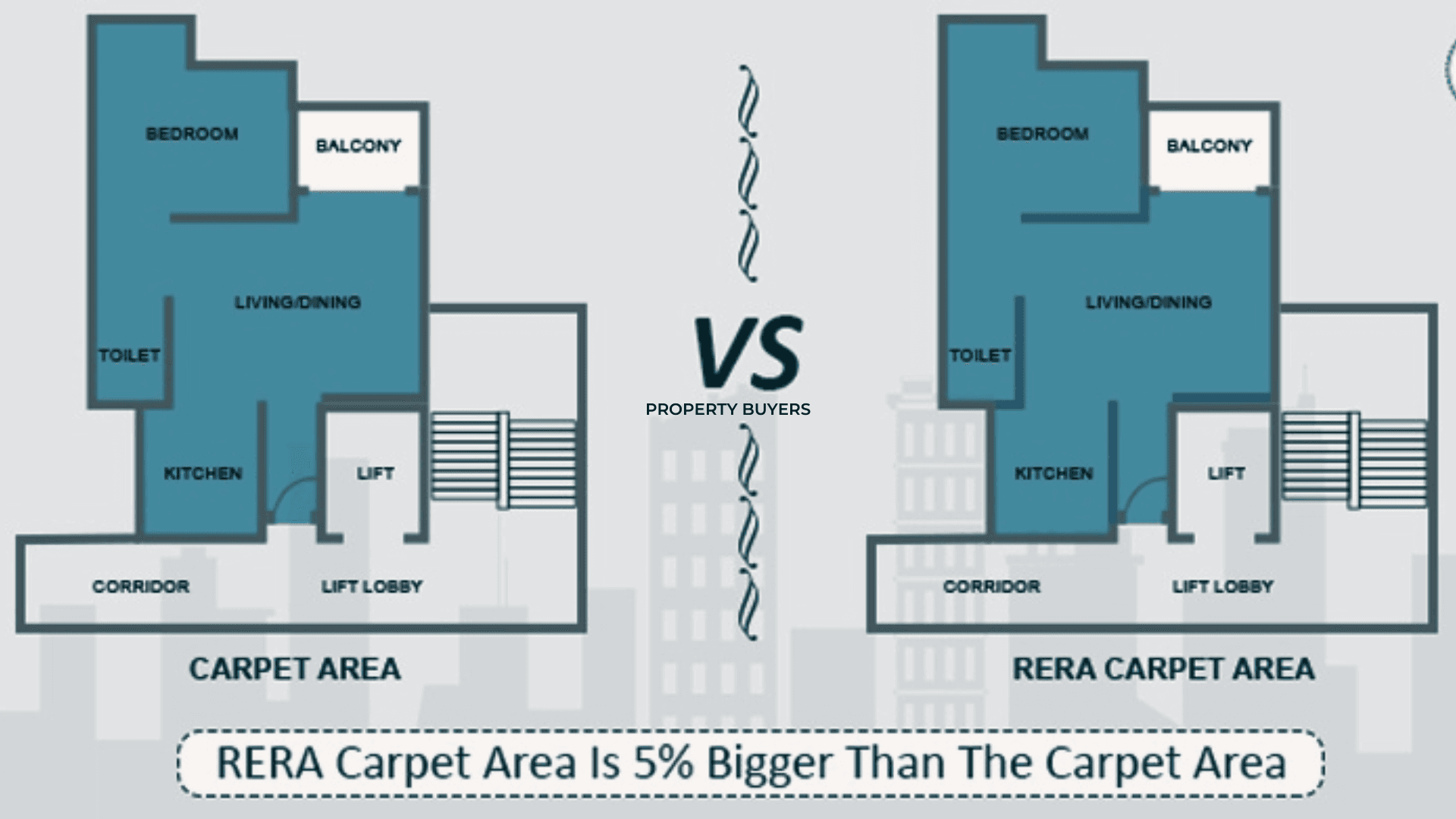

A flat sold as 2,000 sq ft built-up area may give you only about 1,400 to 1,500 sq ft of real usable space. That gap is not a small detail; it can change the price you think you are paying by lakhs of rupees.
The contrarian truth is simple: the bigger number is often the less useful number. If you want to compare homes fairly in 2026, start with RERA carpet area, not built-up or super built-up area.
Start with the number that is legally defined
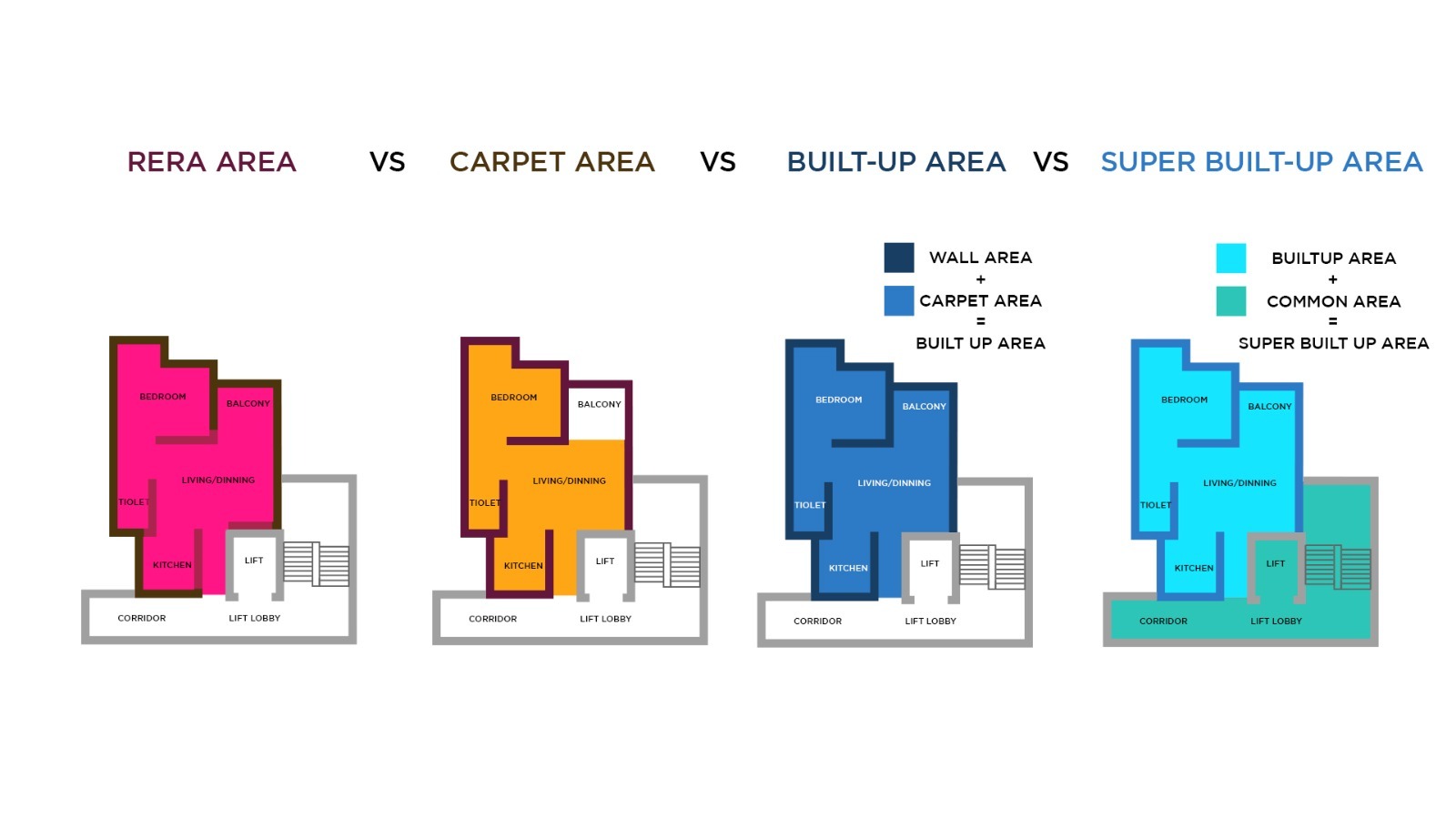
RERA carpet area means the net usable floor area inside the flat, but with one important point: it includes the area covered by internal partition walls. It does not include external walls, service shafts, exclusive balcony, verandah, or open terrace area.
This definition comes from the Real Estate Regulation and Development Act, 2016. That makes it different from casual terms used in ads, brochures, and sales calls.
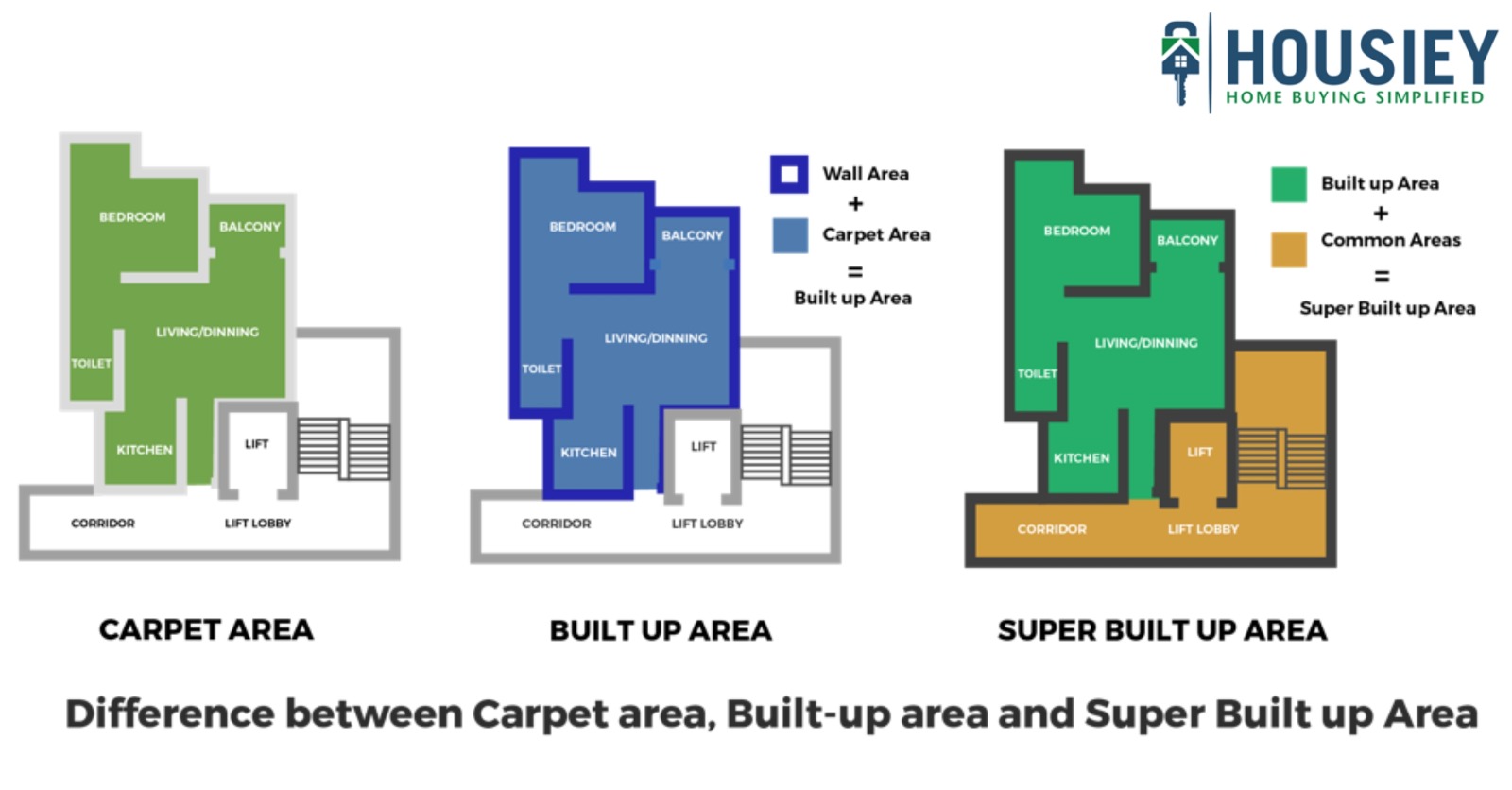
Built-up area is usually the carpet area plus wall thickness and other attached areas such as balconies or utility spaces, depending on how the builder presents it. This is why built-up area is almost always higher than RERA carpet area.
For a buyer, the key question is not “How large does the flat sound?” The better question is “How much space can my family actually use, and what am I paying for each usable square foot?”
Use this checklist before trusting any area figure
Many buyers compare two flats by looking at the largest area printed in the brochure. That is a mistake. A clean comparison needs the same type of area on both sides.
Before you finalise a deal, ask the builder or broker to break the area into clear parts. Do not accept only one big number.
- Ask for the RERA carpet area: This should match the project details on the state RERA website.
- Ask for the built-up area: Check what has been added over the carpet area.
- Separate balcony and terrace: These should not be mixed with RERA carpet area.
- Check the agreement value: Make sure the price is linked to the correct area type.
- Compare price per usable sq ft: Divide the total price by RERA carpet area, not by built-up area.
- Save written proof: Keep the brochure, cost sheet, RERA page screenshot, and draft agreement.
Under RERA, projects with more than 500 square metres of land area or more than 8 apartments generally need registration, unless exempt under state rules. This gives buyers a public place to verify basic project details.
If you are also checking loan rates, rent-versus-buy math, and project registration status, this Complete Guide to India’s May 2026 Property Market: Home Loan Rates, Rent vs Buy, and RERA Checks can help you connect the area numbers with the larger buying decision.
Real price examples: why the smaller area can show the real cost
Let us compare two flats with the same headline price of ₹1.20 crore. On paper, both may look similar. But the usable space can tell a different story.
Flat A has a built-up area of 1,000 sq ft and a RERA carpet area of 750 sq ft. The builder says the rate is ₹12,000 per built-up sq ft, so the total is ₹1.20 crore.
But if you calculate the cost on RERA carpet area, the real usable-space rate becomes ₹16,000 per sq ft. That is the number you should compare with other flats.
Flat B has a built-up area of 950 sq ft and a RERA carpet area of 790 sq ft. It also costs ₹1.20 crore. On built-up area, Flat B looks smaller. On usable area, it gives you 40 sq ft more than Flat A.
This is why the common rule that carpet area is around 70% to 75% of built-up area is only a rough guide. Some layouts are more efficient. A well-planned flat with fewer dead corners can feel bigger than a badly planned flat with a higher built-up number.
Here is a simple way to judge layout efficiency:
- Good efficiency: RERA carpet is close to 75% or more of built-up area.
- Average efficiency: RERA carpet is around 70% to 75% of built-up area.
- Weak efficiency: RERA carpet is below 70% of built-up area.
This does not mean every flat below 70% is bad. But you should ask why the loss is high. It may be due to thick walls, large balconies, design waste, ducts, or shared features being marketed in a confusing way.
A useful habit is to compare homes like you would compare a match scorecard before a big game. Do not look at one headline number only. If you enjoy that kind of number-by-number reading, you may like this KKR vs MI IPL 2026 Match 65 Preview, but for property, the scorecard that matters most is the RERA area statement.
What most people get wrong
Mistake 1: Thinking RERA carpet area and normal carpet area are always the same. They are not always the same. RERA carpet area includes internal partition walls, while many people use “carpet area” to mean only the space where a carpet can be laid.
Mistake 2: Treating balcony as carpet area. A private balcony may be useful and valuable, but it is not part of RERA carpet area. It should be shown separately.
Mistake 3: Comparing one builder’s carpet area with another builder’s super built-up area. This makes the cheaper-looking flat seem like a better deal. Always compare RERA carpet to RERA carpet.
Mistake 4: Ignoring regional selling habits. In Mumbai and many Maharashtra markets, buyers often talk in carpet area because MahaRERA has made this more common. In Bengaluru, NCR, and some other markets, brokers may still use built-up or super built-up area in early conversations. Ask them to convert it clearly.
Mistake 5: Forgetting parking. Parking is not carpet area. A garage or parking right may affect the total cost, but it should not be mixed into the flat’s usable internal area.
Mistake 6: Not checking the final agreement. The brochure may say one thing, the cost sheet another, and the agreement a third. The agreement for sale should clearly mention carpet area as per RERA.
FAQ
Is RERA carpet area the same as built-up area?
No. RERA carpet area is smaller and more specific. It covers usable internal area and internal partition walls, but excludes external walls, service shafts, exclusive balcony, verandah, and open terrace. Built-up area is broader and usually includes wall area and attached spaces.
What percentage of built-up area is RERA carpet area?
In many flats, RERA carpet area is around 70% to 75% of built-up area. But this is not a fixed law. A compact, well-designed flat may have a better ratio, while a poor layout may give less usable area.
How do I calculate the real cost using RERA carpet area?
Use this formula: Total flat cost divided by RERA carpet area. For example, if a flat costs ₹90 lakh and has 600 sq ft RERA carpet area, the real cost is ₹15,000 per usable sq ft.
What is the difference between built-up and super built-up area?
Built-up area usually means carpet area plus walls and attached spaces. Super built-up area adds a share of common areas such as lobby, lift area, staircase, clubhouse, or corridor. Super built-up area is often the biggest number, but it is the weakest number for judging your private usable space.
Can I ask the builder for a RERA carpet area PDF?
Yes. Ask for the approved floor plan, area statement, cost sheet, and RERA registration details in PDF or email form. Also check the state RERA website yourself. A serious seller should have no problem sharing written area details.
Should I pay more for a flat with a larger balcony but smaller RERA carpet area?
Only if you will use the balcony often and the price still makes sense on RERA carpet area. For most families, indoor usable space is more valuable than a large balcony that is rarely used.
Final recommendation: Use RERA carpet area as your main buying number, and treat built-up area as a supporting detail only. Before paying a booking amount, compare the price per RERA carpet sq ft, verify the same area on the state RERA portal, and get every area split in writing. If two flats cost the same, choose the one with higher RERA carpet area and a cleaner layout, not the one with the bigger marketing number.

*Affiliate link — we may earn a small commission at no extra cost to you.
Education journalist covering competitive exams, board results, and career transitions in India. Her CBSE and higher education coverage has helped thousands of students navigate admissions.